A brief history online
My first time online was connecting to Prestel using an Acorn Electron and a 1200 baud modem. My father used to work for Hayes, and they used Electrons to test their modems as part of their quality assurance.
Several of these test machines ended up winding their way back home to us. They’d had a hard life so didn’t always last very long, but I have cherished memories using mine to dial up and connect to the wider world. I must have been around 12 at the time and I felt like I was pushing limits, entering new and unexplored territory — a window onto somewhere else entirely, and I sat on the living-room floor in front of the television to look through it.
Prestel was a lot like Teletext, but rather than reading static pages broadcast to everyone, I was in control. I could navigate and upload information — it was a two-way street. That distinction mattered more than I understood at the time; I wasn’t a viewer any more, I was a participant, and the line went both ways.
Later on, my dad upgraded to a 14.4K modem and I have fond memories connecting to the odd BBS. I remember waiting around 20 minutes to download a simple graphic of the starship Enterprise. It wasn’t very spectacular, but being able to download something from somewhere else, and not being limited to whatever files we had locally, was magical. And then came the internet, and the little worlds you dialled into one at a time started joining up into one enormous one.
# Kicked off the line
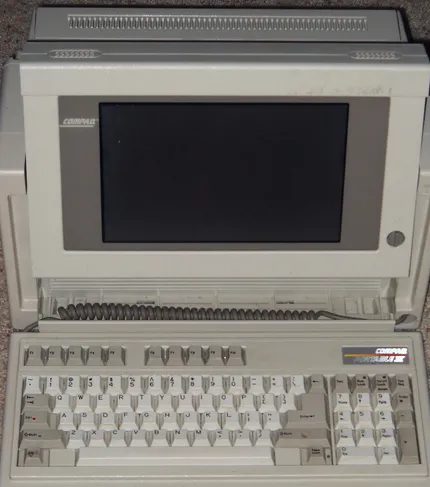
My early time online was via a Compaq Portable III — a “luggable” that I would bring downstairs and connect to the phone line. I wasn’t allowed online for long due to the cost, and despite the reasonable 1p/minute call charge and me offering to pay £1 to connect for an hour or so, I was often kicked off after a short period. I also didn’t have a very fast modem and only an orange CGA screen (albeit it was gas plasma!), but I made the most of it.
Modems improved over the years with 28.8K, 56K, and then the pièce de résistance: dual ISDN+2E (two digital 64K channels) that were still technically dial-up, but there were no per-minute fees and they connected almost instantly — no more long handshake sequences, however charming they were. Fast forward to today and I have a Gigabit fibre connection, almost one million times faster than my original modem on the Electron. Times have changed.
# 3329 Sunset Strip
Like many early surfers, and what was almost a rite of passage back then, I created my first website. It was 1997 and GeoCities had launched a couple of years earlier, and I found myself a home at 3329 Sunset Strip — their suburb dedicated to rock, grunge, punk and the club scene. My site was about happy hardcore; I was already an active member on a busy happy hardcore newsgroup and I wanted to create my homage to the genre.
I was using a WYSIWYG tool provided by my ISP and I’d created my first page. I had some text that I wanted to align to the left (by default everything was aligned to the centre) and I couldn’t see an obvious way to do it — but I did notice an option to look at the source. I clicked the button and was presented with some mystical text, but I could see there was something that said align center, and I changed it to left, and it worked.
I had no idea what HTML was or how align attributes worked, but I’d made a manual edit and could see how that changed the look of the page. It may only have been aligning some text, but I was chuffed with myself, and I was hooked.
Shortly after that my dad bought me a thick book about HTML and I read it back to front. I wanted to learn everything I could, and it led me on the path I’m on today.
I’ve designed many sites since, but none hold a place in my heart quite like my first GeoCities site.
# Lost, then found
GeoCities was bought by Yahoo some years later, who dropped it entirely in 2009 — overnight, hundreds of thousands of voices from the earliest days of the internet were gone, seemingly lost to time.
Thankfully, others understood and appreciated the importance of the ragtag communities we’d built, and several projects undertook the effort to archive as much as they could prior to the servers going offline. Over 900 GB of content was released as a torrent in 2010, and there are currently several other sites hosting similar archives. It’s a treasure trove of early ideas and expressions, and whilst some people may write off most GeoCities sites as amateurish, I think they’re missing the point — the web was a new medium back then, and GeoCities gave people a canvas to express themselves. There was something magical about those heydays, and sadly I don’t think we’ll ever truly capture it again, but I’m glad I was there and I played a part in my own small way.
And, after some searching, I’ve found a 29-year-old backup of mine. My site still exists online in various archives, but they had unfortunately failed to capture the RealAudio content — so today, for the first time in over 29 years, I present Federation Hardcore restored in all its glory. I’ve converted the RealAudio to MP3s and made some other minor tweaks for modern browsers.
 UK Happy Hardcore Central, est. 1997Federation Hardcore↗ enter the archive
Long live happy hardcore.